

Dr. Carmen Simon‘s presentations and workshops help business professionals to use communication and presentation skills to increase revenue, train or motivate others and overall, stand out from too much sameness in the industry. A published author, Dr. Simon is frequently invited as a keynote speaker at various conferences.
In this conversation, Carmen discusses how you can create more memorable slides.
Geetesh: Why do people forget some parts of a presentation, and continue to remember other parts?
Carmen: Memory of specific slides (at the sacrifice of other slides) depends on a variety of factors:
Level of attention
It is harder to remember what we don’t pay attention to in the first place.
Existing knowledge
For example, technical audiences will have no problems understanding complex slides while novices may struggle.
Goals
If I know I will have to prove to my boss that I learned something from a presentation, I will pay attention and remember things, even though the presentation was dull.
The amount of sleep we get impacts our memory. You can have the most amazing slides – if you present them to sleep-deprived audiences who are in a state of partial attention, the recall will not be high.
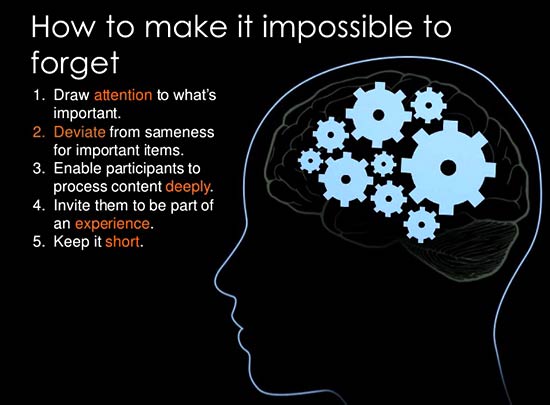
Geetesh: Is there something we can do on our slides so that the recall levels are high?
Carmen: There are many reasons people forget presentations. I will address one that has become prevalent in business settings. For the past few years, a new trend has been emerging: it used to be that people would complain about text-intensive slides. “Death-by-PowerPoint” was a typical phrase we’d hear. However, with the emergence of “Zen-like” presentations, many presenters have felt compelled to go to the other extreme: slides with just a few keywords, or slides with just one picture.
These two approaches have advantages and disadvantages, and both impact memory. Convoluted slides are easily forgotten because complex information offered in abundance makes an audience give up and search for easier forms of stimulation (such as checking an email). Simple slides are easily forgotten because, even though people have a good time during the presentation, there are not enough memory traces formed to retrieve later.
A good approach for a memorable presentation is to provide audiences a combination of simple and complex slides. This flow will also make the presentation less predictable, which means you will receive more attention; and attention paves the way to memory.
The views and opinions expressed in this blog post or content are those of the authors or the interviewees and do not necessarily reflect the official policy or position of any other agency, organization, employer, or company.
Related Posts
 Simon Morton founded Eyeful Presentations in 2003 to provide presentation services to businesses looking to improve the way th...
 Dr. Carmen Simon's presentations and workshops are unique because she applies a scientific methodology to her coaching. Unlike...
 Martin Conradi is managing director of Showcase Presentations in London. Educated at Oundle School and Lancaster University, he spent 10 y...
 David Tang (Dave Tracy) has worked as a management consultant for 12 years. During this time, he worked at a numbe...