
“Get on with it!”
Senator Barry Goldwater, the Republican candidate for president in 1964 infamously said, Extremism in the defense of liberty is no vice. And moderation in the pursuit of justice is no virtue.
This misguided view of political policy became a major factor in Mr. Goldwater’s landslide loss to Lyndon Johnson, but it also serves as a warning lesson for presenters. Extremism in any pursuit can overshoot the mark and result in the opposite intent of the pursuit.

Image: 123RF
One of the most frequently repeated pieces of advice for presenters is to Tell ’em what you’re gonna tell ’em, tell ’em, and then tell ’em what you’ve told ’em.
In fact, I offer the same advice in my own coaching practice and writing. The intent is to impose and maintain a clear narrative flow in presentations and speeches; and the reason it is repeated so often is that most presenters and speakers, who regularly crank out long, rambling, pointless patchwork pitches, desperately need reminding. The Triple “Tell ’em” is one solution. However, too much of a good thing can be a bad thing; a sword can cut two ways.
Bruce Eric Kaplan, a cartoonist who appears regularly in the New Yorker magazine as BEK, skewered the excessive Triple “Tell ’em” with a panel that showed a presenter in front of an audience, saying, First, I want to give you an overview of what I will tell you over and over again during the entire presentation.
We’re also painfully familiar with presenters who impose a narrative laundry list on their bullets by saying “First, I’d like to talk about…” then move on to the second bullet saying, “Next, I’d like to talk about…” and then proceed through every bullet the same way until the end, when they say—wait for it— “Last but not least…”
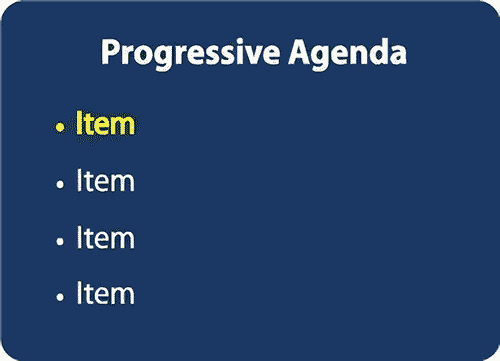
Some presenters push their extreme handholding even further, by utilizing their slides to do the tracking. As in the figure above, they insert copies of an agenda slide between the sections of their presentation, progressively shifting the highlighted bullet to “Tell ’em what they’re gonna tell ’em” in the upcoming section. This technique can be useful in long tutorial presentations, but if there are only one or two slides between the variations of the agenda in short presentations—and short presentations are obligatory in this 140-character day and age—the audience, feeling patronized, will react with a big Duh!
Presenters are not the only perpetrators of such deliberate continuity devices. Geoff Dyer, who writes the “Reading Life” column for the New York Times Book Review section, considers excessive tracking a “basically plodding method.” In one of his columns, he criticized art historian Michael Fried, whose book, Why Photography Matters as Art as Never Before, takes “the style of perpetual announcement of what is about to happen to extremes.”
Mr. Dyer said it is like watching a rolling news program: Coming up on CNN . . . A look ahead to what’s coming up on CNN.
Concluding his critique, Mr. Dyer wrote, I kept wondering why an editor had not scribbled ‘get on with it!’ in huge red letters on every page of the manuscript.
To keep your audience from thinking “Get on with it!” apply the Less is More rule, not just in your slide design but in your content. As you read in the prior posts, Kill Your Darlings, and How Long Should a Presentation Last?:
- Edit the amount of material you present
- Be brief AND concise
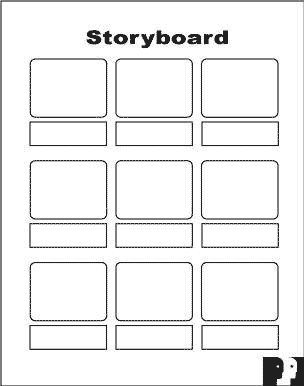 Then, with a shorter and more succinct story, look at your presentation from a 35,000 foot view—as a storyboard—in the Microsoft PowerPoint Slide Sorter view, or with the Power Presentations Storyboard form in the accompanying figure. It’s downloadable from our website.
Just as television and film directors use storyboarding to see the full scope of their stories, look at your slide show in this panoramic view to see your flow. Then rehearse your presentation aloud, moving from frame to frame. Do this several times. Along the way, you’ll find that you might want to add, delete, or shuffle slides. As you proceed with your iterations, you will develop verbal connective links for your narrative.
Ultimately, you will have a presentation in which The Triple “Tell ’em” is transparently implied. You will have a story that will be easy for you to deliver and, more important, easy for your audience to follow—without a laundry list, without CNN-style teasers, and best of all, without those patronizing agenda slides.
Get on with it!

Jerry Weissman is the founder and president of Suasive, Inc., formerly Power Presentations, Ltd. Jerry founded Suasive in 1988 and quickly established himself as the coach for Silicon Valley CEOs delivering critical presentations for their IPO roadshows. He taught them to tell their company stories through the eyes of their investors, and in so doing, significantly increased the valuations of their companies. He amassed an elite client list and soon widened his focus to helping public and privately held companies develop and deliver all types of business presentations.
The views and opinions expressed in this blog post or content are those of the authors or the interviewees and do not necessarily reflect the official policy or position of any other agency, organization, employer, or company.
Related Posts
 By Jerry WeissmanThe world recently lost one of its best human beings when Vin Scully, the radio voice of the Los Angeles Dodgers for 67 astounding ye...
 By Jerry Weissman“Words, words, words! I get words all day through,” are the exasperated lyrics exclaimed by the title character of My Fair Lady, the ...
 By Jerry WeissmanThe step-by-step process to get past the proverbial blank page of the previous blog is as applicable to presenters as it is to writer...
 By Jerry WeissmanWriter’s block is the proverbial stuff of legend and literature. A variation on the theme is Limitless, a Hollywood film starring Bra...