

 (5 votes, average: 4.20 out of 5)
 Loading...
David Tang is the founder of Flevy, the marketplace for business best practices–the same as those produced by top-tier consulting firms and used by Fortune 100 organizations. Flevy is the largest library of best practice documents available online. Prior to Flevy, David worked as a management consultant, where his clients ranged from startups to Fortune 15. David has a MEng and BS in Electrical & Computer Engineering from Cornell University.
In this conversation, David talks about PPT Depot.
Geetesh: David, what inspired you to launch PPT Depot, especially when Flevy is already such a successful platform? Was there a “eureka” moment that made you realize the world needed PPT Depot?
David: The spark came from a long time business partner who has run a slide production firm for 15 years and now produces roughly 200,000 slides annually for consulting and financial services clients. After seeing a steady rise in requests for modernized consulting grade PowerPoint templates–and noticing how few providers truly nail that look–he urged me to team up and create a subscription service dedicated to tier 1 consulting design.
His insight resonated. Many “template libraries” look polished at first glance, yet the layouts, diagrams, and data visuals rarely match the rigor or aesthetics expected in board level decks. Furthermore, upon investigating this market further, I’ve found a lot of mistakes in the diagrams from the existing players–particularly for templates that capture specific business frameworks.
Furthermore, I was attracted to the subscription-based business model, which offered a more stable, reliable, and less seasonable revenue stream than Flevy’s pay-per-download marketplace.
Geetesh: What differentiates PPT Depot from other PowerPoint template subscription services?
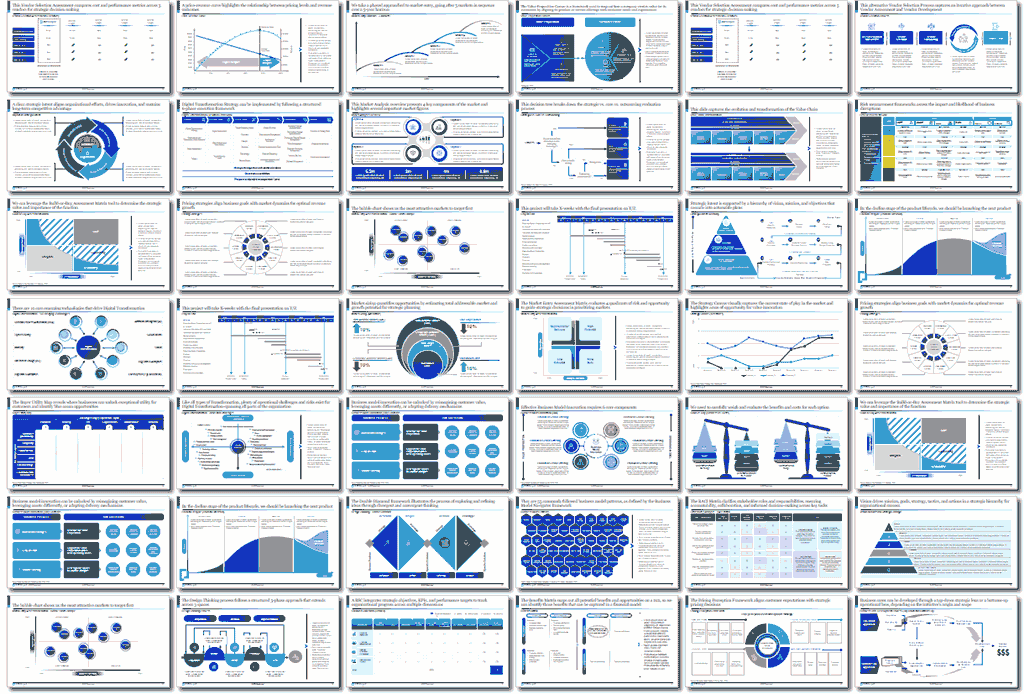
David: PPT Depot is built from pure consulting DNA. Every designer on our team is a former McKinsey Visual Graphics specialist, so our templates follow the precise structure, typography, and white space discipline seen in top tier consulting decks. Our templates are also based on from real-world client deliverables from MBB and Big 4 firms. This means our diagrams, frameworks, and charts are field tested, rather than speculative.
We release every template set in 3 color palettes–Azure, Emerald, and Crimson–mirroring the visual identities of McKinsey, BCG, and Bain. This allows our clients the flexibility to adopt whichever tone best fits their own brand.
Geetesh: Are the templates on PPT Depot mostly slide decks or modular slide libraries? How do you see users actually putting them to work?
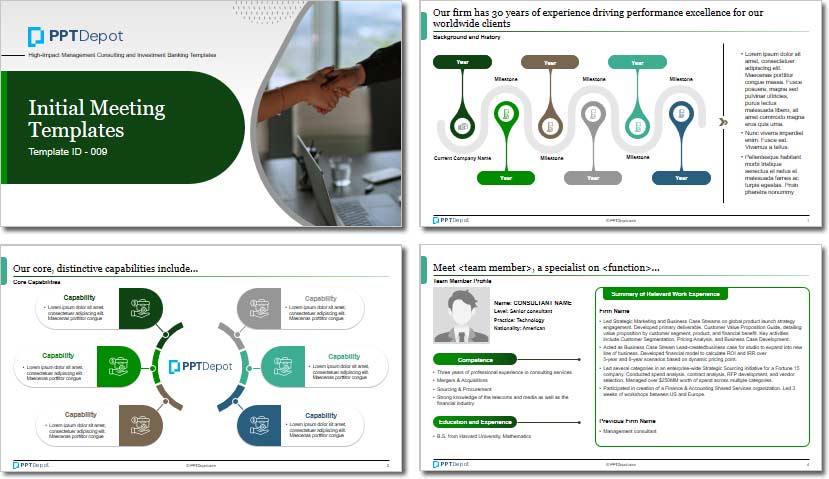
David: We curate complete slide decks, each focused on a specific use case, so busy teams can drop in a full storyline or cherry pick individual templates. Current categories include:
- Management Topics: Collections of templates that align with a specific functional topic a consulting firm may be working on (e.g. Market Analysis, Design Thinking, Digital Transformation, etc.).
- Industries: Decks tailored to individual industries and populated with sector specific content (e.g. Artificial Intelligence, Healthcare, Robotics, etc.). Templates include competitive landscapes, global investment maps, and vertical breakdowns.
- Deal Tombstones: These templates feature the classic diagram style used to showcase M&A and capital markets transactions in credentials decks and pitchbooks.
- Maps: Whereas many PPT maps are commonplace, we specialize in difficult to find maps (e.g. US state maps with county borders); and economic and political defined regions (e.g. MENA, BRICS, G7, etc.).
- Shapes: Collections of common business diagrams used in consulting and executive presentations, organized by shape archetype (e.g. Diamonds, Flow, Buildings & Pillars, etc.).
Later this year we’ll roll out additional libraries (e.g. KPI dashboards). Ultimately, consultants and bankers can treat PPT Depot as a one stop source for ready to present slides–easily dropping a full deck into client work or cherry picking individual pages and diagrams to accelerate their build.
Geetesh: You’ve been helping people work smarter with PowerPoint for over a decade. What’s the biggest shift you’ve seen in how professionals use PowerPoint today?
David: I’ve noticed two primary shifts in PowerPoint usage and design over the past decade.
The first is a move away from the minimalistic, “classic” 90s and 2000s consulting slide–defined by flatter, more complex diagrams and uniform fonts–toward a modern, infographic aesthetic that relies more heavily on icons, vectors, gradients, and varied typography. While Flevy caters to both design styles, PPT Depot is dedicated to delivering the modern look.
The second shift is the widespread reliance on ChatGPT and other large language models. Professionals now use these tools both to generate slide content and to obtain design guidance.
Together, these changes have fundamentally altered the slide creation process, especially in consulting. In the pre-ChatGPT era, consultants typically began by sketching slides on paper and handwriting key text. Today, that initial sketch phase is often replaced by a prompt to ChatGPT; and its output is either converted directly into slides or passed to a slide production team.
The result is a faster pace of slide production and, in most cases, reduced diagram complexity.
Geetesh: How does PPT Depot compare with the emerging AI based slide production tools?
David: Based on what I’ve seen, AI generators specialize in quick, marketing style decks–i.e., hero images with sparse bullets. Consulting and banking slides look completely different: multi layered frameworks, tightly aligned shapes, symbolic color coding, and data heavy charts. PPT Depot focuses exclusively on this second category.
Our entire design team is comprised of former McKinsey Visual Graphics presentation specialists who are trained on this secondary of slides. Our designers ensure every diagram aligns perfectly to the grid, every chart integrates editable data, and every layout communicates a clear logic flow.
The views and opinions expressed in this blog post or content are those of the authors or the interviewees and do not necessarily reflect the official policy or position of any other agency, organization, employer, or company.
Related Posts
 David Tang is the founder of Flevy, the marketplace for business best practices--the same as those produced by top-tier consul...
 David Tang is the founder of Flevy, the marketplace for business best practices--the same as those produced by top-tier consul...
 David Tang is the founder of Flevy, the leading provider of business frameworks and analysis tools. Flevy's mater...
 David Tang is the founder of Flevy, the marketplace for business best practices--the same as those produced by top-tier consul...