
 (3 votes, average: 5.00 out of 5)
 Loading...
We have discussed visual clichés in the past. The idea has been to explain how you can overcome these visual clichés by using the four principles of:
- Thinking creative,
- Thinking profound,
- Thinking logical, and finally
- Thinking again.
In a recent case study on clichés, we spoke about how everyone thinks about a light bulb when they need to express a bright idea. In fact, a search on Google Images for the term, “bright idea” singularly returns only visuals of light bulbs!
Recently, a picture featuring an unusually large number of light bulbs was noticed in an Accenture advertisement. Strangely, this did not seem clichéd. Why did this happen? Why did the cliché go away?

Is that because there is a way of overcoming a visual cliché, and that is to go overboard with the actual cliché itself! As they say, there is safety in numbers. Do too many instances of the same cliché make it a pattern? And do patterns make clichés insignificant? That’s something interesting, and can help you when you have few options to go beyond a visual cliché.
Patterns are created using multiple instances. Why do multiple instances of the same cliché negate each other? The answer to that question may be the fact that poison kills poison—at least this last metaphor of poison killing poison is very well known in the Orient and in India.
In the Mahabharata, an Indian epic, there is the story of Duryodhana, who planned to kill his cousin Bhima. He tried to execute this plan by poisoning Bhima’s food. And then, when Bhima fainted as a result, Duryodhana threw him into a nearby river. Poisonous snakes in the river bit Bhima, and this poison negated the poison that Bhima had earlier consumed. Thus, Bhima swam up the river and survived to one day kill Duryodhana!
And it seems like this poison kills poison metaphor may work with clichés too! One cliché may get negated with multiple instances of the same cliché.
So, is it possible that you can overcome a cliché by going overboard? That’s food for thought! We have found that this approach can work sometimes, but only if implemented thoughtfully and tastefully.
The views and opinions expressed in this blog post or content are those of the authors or the interviewees and do not necessarily reflect the official policy or position of any other agency, organization, employer, or company.
Related Posts
 Let’s admit that coins can look beautiful, especially if they are golden! Add an interesting light source and a stack of gold coins does appear warm a...
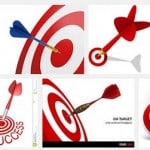 How many times have you seen slides that include pictures of targets and darts, especially when the presenter wanted to emphasize that targets need to...
 If someone wants a visual to express a bright idea, chances are they will use a picture of a light bulb! And probably there are thousands of people wh...
 Rob's presentation had this picture concept and so did Sam’s – and so do countless other slides. What’s this picture concept that populates so many sl...
As I read the intriguing title of the article, I wasn't sure what to expect. You've uncovered an extremely important principle here that has been overlooked for the most part. Most instruction on overcoming visual cliches is structured around thinking differently, picking metaphors that are not overly used, or using icons instead of stock images.
Thank you for this enlightening (pun intended, LOL) article! I am going to give this some thought and I wonder if there are visual cliches like the "handshake" that can be killed using this principle. I'm going to give it some thought…
@Sam, I think this approach does have its merits but no solution can really be a formula that can work all the time. Yes, it does work with light bulbs but will it work the same way with handshakes? Incidentally, we did look at handshake clichés in another article!
What's funny for me about this post is that Accenture (and Andersen Consulting in its prior incarnation) was the place where, for nine years, I helped create thousands of presentations and practiced exactly what you warn against here. I guess some change comes rather slowly, if ever.