

Jerry Weissman is the founder and president of Suasive, Inc., formerly Power Presentations, Ltd. Jerry founded Suasive in 1988 and quickly established himself as the coach for Silicon Valley CEOs delivering critical presentations for their IPO roadshows. He taught them to tell their company stories through the eyes of their investors, and in so doing, significantly increased the valuations of their companies. He amassed an elite client list and soon widened his focus to helping public and privately held companies develop and deliver all types of business presentations.
Today his methodology has helped thousands of companies on every continent deliver mission-critical presentations with clarity, confidence, and maximum persuasion. Jerry is the author of five books on presentations, among them the recently released trilogy: Presenting to Win, The Power Presenter, In the Line of Fire, and regularly blogs for Forbes.
In this conversation, Jerry talks about the recently released 3rd edition of his book, In the Line of Fire.
Geetesh: Jerry, you updated the In the Line of Fire book to the third edition a while ago. Who was this book written for, and what motivated you?
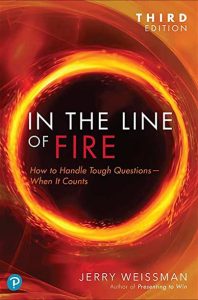 Jerry: I wrote this book for both businesses and not-for-profit organizations who, like any entity seeking to affect change—to persuade via presentations—must face tire-kicking in the form of tough questions. What motivated me is that most other approaches to handling tough questions are often treated as a separate entity—as a PR or media training function—which leaves a gap in the preparation. Because I wrote and Pearson published In the Line of Fire along with Presenting to Win and The Power Presenter as a trilogy, readers can learn the necessary skills to develop all the elements of their presentations as an integrated entity.
Geetesh: In the Line of Fire is your third book in the trilogy of Presenting to Win, The Power Presenter, and In the Line of Fire. In the Line of Fire is different from the other two books in some ways. Can you tell us more about this difference, and why is this so significant for readers?
Jerry: It’s both different and the same. Different in that it shows readers how to handle and respond to the questions that either interrupt or come at the end of the presentation; and the same in that it ties the preparation for the questions directly to preparing every other aspect of the presentation that the other books cover: the structure of the story, the design of the slides, and the delivery of narrative. The reason this is important is that each of those elements must be developed to anticipate the worst-case scenario and to prepare an effective response either preemptively or in the moment.
There is another different/same aspect in that this third edition has the same basic techniques and best practices as in the first two editions, refined and tweaked over the 16 years (since the first edition) of battle testing in the Suasive programs. The big difference is that, in this edition, I have replaced most of the political case studies with business case studies, also drawn from the companies I have coached in the Suasive programs.
The views and opinions expressed in this blog post or content are those of the authors or the interviewees and do not necessarily reflect the official policy or position of any other agency, organization, employer, or company.
Related Posts
 Jerry Weissman is the founder and president of Suasive, Inc., formerly Power Presentations, Ltd. Jerry founded Suasive in 1988...
 Jerry Weissman is the founder and president of Suasive, Inc., formerly Power Presentations, Ltd. Jerry founded Suasive in 1988...
 Jerry Weissman is among the world's foremost corporate presentations coaches. His private client list reads like a who's who o...
 Jerry Weissman is among the world's foremost corporate presentations coaches. His private client list reads like a who's who of the world's best compa...