
This is the print version of this page. All content is copyright Indezine.com 2000-2026.
Thoughts and impressions of happenings in the world of PowerPoint and presentations, continuously updated since 2003.
See Also:
PowerPoint and Presenting Notes
PowerPoint and Presenting Glossary
Apply any of the various effects in PowerPoint, and your shapes may stand out; literally out of the slide! In this series on Shape Effects in PowerPoint 2016, we have explored several effect types. On this page, you will learn how you can quickly add a convincing Reflection effect to a shape.

Learn how to apply Reflection effects to selected shapes in PowerPoint 2016 for Windows.
Filed Under:
PowerPoint 2016
Tagged as: Effects, Microsoft Windows, Office 2016, PowerPoint 2016, Reflection, Shapes, Tutorials
Comments Off on Apply Reflection Effects to Shapes in PowerPoint 2016 for Windows
A lot of work goes into creating slides with PowerPoint. But what happens with your presentations after creating them? Sometimes they are used for presentations at events, and some other times, you simply share the documents as marketing white papers. Mostly, there is not much information which you receive after sharing the document, and only a fractional number of the viewers will get in touch with you afterward. Instead of neglecting the presentation-sharing process, you should invest adequate effort into marketing your presentations effectively.
Most presentations have one common goal: marketing yourself and your business. Especially in the business context, generating leads with your pitch deck is equally important to delivering great content. However, it can be tough to get the viewers’ contact details nowadays. At events as well as online, you always face competition from many other slide decks. While many presentation tools focus on creating better presentations, few tools emphasize the importance of sharing slides. The well-known presentation platform SlideShare recently decided to shut down the tool’s lead feature as well. In contrast to traditional ways of sharing slides without much feedback, interactive features and analytics are needed to find out which slides the audience likes most and where they churn your slideshow.
Filed Under:
Guest Posts
Tagged as: Beamium, Guest Post, Opinion, Philip Franta, PowerPoint, Share
Comments Off on Beamium: The Smarter Way of Sharing PowerPoint Presentations
The shadow effect in PowerPoint adds more depth to your selected shape, and you may achieve the perfect shadow effect the very first time you use PowerPoint’s default shadow options. However, you may want that shadow to be a wee bit longer, or just a little less pronounced. Or maybe you want the shadow to sport a color that’s different.

Learn about options to edit the Shadow Effect in PowerPoint 2016 for Windows.
Filed Under:
PowerPoint 2016
Tagged as: Effects, Microsoft Windows, Office 2016, PowerPoint 2016, Shadow, Shapes, Tutorials
Comments Off on Advanced Shadow Options in PowerPoint 2016 for Windows
While some applications may allow you to identify font types while you choose a font, many times you may not know which font type you are choosing. And by font type, we mean the various font file formats that are recognized by Microsoft Windows and are available to most installed programs. To identify font types, you first need to see a listing of all fonts installed on your system.

Learn how to identify font types in Windows 10.
Filed Under:
PowerPoint 2010
Tagged as: Fonts, Microsoft Windows, Tutorials
Comments Off on Identify Font Types in Microsoft Windows 10
At the Presentation Summit, before Nancy Duarte began her keynote, Rick Altman did a Seinfeld impersonation about a head of lettuce! He then reminisced about Nancy’s involvement with the Presentation Summit back in 2003, which was then called PowerPoint Live.
Nancy started her session by mentioning how happy she was to see many recognizable faces. She observed that while much has changed since 2003, presenting faces the same challenges. She acknowledged the presenting firms spearheaded by MVPs and so many other people. Nancy attended an Entrepreneurs’ Roundtable for presentation agency owners the previous night and reconfirmed that people in the presentation industry play a role in changing the world.
Below are some remarks from her talk:
Everyone in this room can create something out of nothing. Leaders imagine and then lead others into the future.
She projected the Venture Scape from her new book, Illuminate that illustrates why change is essential.
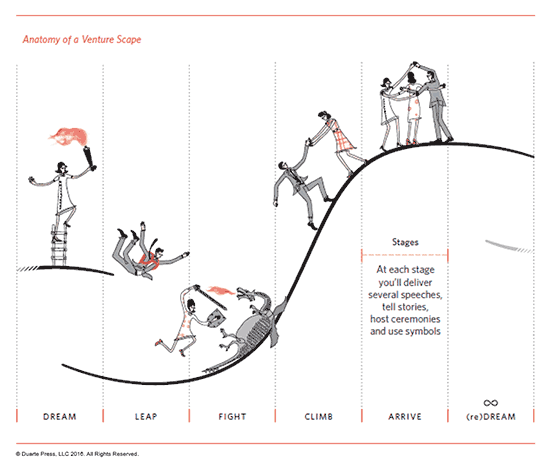
She mentioned that innovating requires constant reinventions. Her own company, Duarte has been through eight reinventions in the last twenty-eight years; that means there has been a reinvention every four years. If there is no reinvention, small businesses, on an average, fail every four years. To avoid failure, we have to be on our toes; we must be ready for a change.

She spoke about her husband, Mark Duarte who started as a freelancer. Nancy joined him later and they evolved as a service bureau. Nancy added:
We did whatever work we could, and then intentionally decided to be a design team. We needed to transform ourselves.
Nancy then mentioned the impact Jim Collins’ book Good to Great had on her firm, which said:
If there is one thing that you can do, be best in the world at, passionate about and profitable at, do just that one thing.
So her firm decided to only do presentations.
The eight Duarte reinventions are:

Nancy spoke about her experiences visiting India ten years ago. During this trip, nothing moved her as much a trip to a school where she met hundreds of girls who were creating PowerPoint slides. In these girls, Nancy saw the future workforce. She had already read that India was poised to be the world’s second largest economy by the year 2050.
She had read in the news that 178,000 jobs in the field of graphic design were to be outsourced. This realization set her to think that she had to change her firm once again, and that’s why she began specializing in storytelling. And then, Nancy said:
These young students in India wanted my job; I had to be different.
India’s perception of beauty was different than the US, so I knew I had 10 years.
I had 10 years to convert my shop from only design into storytelling.
Next, Nancy began speaking about her main topic for the keynote: how to use speeches, stories and ceremonies to persuade:
A story has a structure and is a container for info.
People can repeat the last story they heard, but not the last presentation they saw.
When you listen to a story, all the sensory parts of your brain light up.
The brains of the teller and the listener sync while storytelling is happening.
Stories also transport.
When stories are told, the analytical parts of the brain are suspended and open the brain to consider.
Nancy mentioned that stories typically have a 3-act structure:
Nancy then spoke about her own life story with a “messy” middle where she didn’t have empathy modeled for her as a child. This led her to believe that she herself may not be empathic to others, and she has created models of empathy through her books and body of work.
Nancy then spoke about Patti Sanchez, her co-author for Illuminate, their new book:
Patti has a natural gift; a supernatural amount of empathy.

Nancy then spoke about why for some leaders “sharing stories can be hard because they do not want people to know who we really are.” She then shared some more wisdom:
The sense of building and releasing tension is important in a story. Great speeches are structured by contrasting what is, and what could be. Then a great talk ends by articulating the new bliss (the new norm) you want to see established. Because people will remember the last thing you say more than what you say in the beginning and the middle.
Nancy explored a few well-known (and some little-known) speeches that utilized this structure:
She then added that even people who feel they are not qualified can learn and talk with passion and conviction.
From stories, Nancy then ventured to the topic of ceremonies. Ceremonies have been with us for thousands of years, in the form of rituals. Even ceremonies use the 3-act structure:
Nancy spoke more about ceremonies:
Ceremonies demarcate endings and beginning. It helps release what was and embrace something new.
We go through corporate changes—big changes. The past will cling to your staff and clients. You need a ceremony to make it clear what to let go of.
She then shared an anecdote from Steve Jobs’ life. She spoke about how when Steve Jobs returned to Apple ended, they had no OS strategy. Ultimately, they bought Steve Jobs’ company NeXT, Inc., which became Max OS X. But there was resistance from developers who wanted to create applications for this new OS. It was then that Steve Jobs used the power of a ceremony. He actually buried Mac OS 9 in a coffin, shut the coffin, and eulogized it. That was pretty dramatic, but it did convey the message. In fact, Steve himself never uttered “Mac OS 9” again. It was dead to him.
Ceremonies are about ending and beginning. Ceremonies are about ending something so that something new can begin.
From stories and ceremonies, Nancy moved to her third and final topic: transformations.
Nancy added that even transformations follow the 3-act structure:
Nancy then spoke about the 5 stages in the Venture Scape, and how each of them is associated with a different kind of moment:
Nancy spoke about the last reinvention her organization went through. Layers and layers of processes took three years, and everything was rigid and painful. It was around this time that Nancy was writing Illuminate, the book that talks about the Venture Scape, and she found that ironically, her own team was in the Fight/Climb phase, exhausted. So she stepped back in with a moment of Endurance to lead them to the next phase.
So, they hosted “ShopDay”. Everyone was handed a shop apron so they would help work on the shop. Employees shared all the things they felt the company needed to do to improve. Facilitators helped and the final feedback was synthesized. At the end of the day, six teams had to present in 2 minutes without PowerPoint slides what they think the company should focus on.
As a final ceremony, employees created a communal art piece, and this is still on the walls at Duarte.
So she listened to employees and reflected on their comments. She started surveying employees and found that their opinions were polarized. Employees had varying perceptions around what direction the company should take.
So Nancy went back into old presentations and strategies to see the firm endured hardship in the past from the dotcom era in 2001, and she found slides with words that reached out to her. Some of these words were:
Belong
Lead
Innovate
Serve
To her delight, Nancy found that these words formed the acronym, BLIS.
And it was bliss again indeed when Nancy engaged with her employees a while later. Employees asked Nancy and her husband to stand in the middle of a drum circle. And then every employee who was present said part of the prayer that her husband had recited for 26 years.
Here are some closing thoughts from Nancy:
Duarte has recovered, and what changed? The hearts and minds of people.
We undid much of the process put in.
Duarte tries to be torchbearers.
We are trying to make change happen in this industry.
So much of the journey is about how far we all have brought this industry in 10 or 15 years.
We all want to continue to lead this industry into its next glorious place; it is ready for reinvention.
Nancy recollected that she spoke about the story structure in 2010. She asked others to look at their successful talks and the talks of others such as Martin Luther King and analyze. But once you know the rules, you should break the rules a little bit!
Filed Under:
Events
Tagged as: Events, Keynote, Nancy Duarte, Presentation Skills, Presentation Summit, Synopsis
Comments Off on Nancy Duarte at the Presentation Summit 2016
Microsoft and the Office logo are trademarks or registered trademarks of Microsoft Corporation in the United States and/or other countries.