
This is the print version of this page. All content is copyright Indezine.com 2000-2026.
Thoughts and impressions of happenings in the world of PowerPoint and presentations, continuously updated since 2003.
See Also:
PowerPoint and Presenting Notes
PowerPoint and Presenting Glossary
We explored the HSL color model broadly previously. Now, we will look at Luminosity, one of its three properties. So what is Luminosity? Luminosity is the value that spans from pure black (darkest) to pure white (lightest). Now how does Luminosity influence any color? If we change the Luminosity values to 0 (zero) for a given color, it does not matter what Hue or Saturation values they have; they will all be black! This reasoning is easy to explain using an analogy. In a very dark room, if you switch off the light you will be left with pitch darkness, and any object of any color will appear black. That’s precisely what’s happening here too!

Explore how Luminosity works within the HSL color model.
Filed Under:
Color
Tagged as: Color, HSL, Hue, PowerPoint, Tutorials
Comments Off on Color: Luminosity in HSL
We learned about the RGB Color model in a previous tutorial. And while computers can easily understand the fact that you mix red and green to end up with yellow, that’s some strange logic to us humans which we shall never comprehend! For most of us, we understand that mixing yellow and blue makes green. So how can we stay within the RGB color model, which computers understand, and mix colors more creatively to use a method which we humans can understand? This need for a more creative model gave birth to the HSL (Hue, Saturation, and Luminosity) color model.

Learn about Hue, Saturation and Luminosity, and how you can use these properties to mix colors.
Filed Under:
Color
Tagged as: Color, HSL, PowerPoint, Tutorials
Comments Off on Color Models: HSL
By Dave Paradi
I often hear about leaders asking staff members to put a spreadsheet on a slide. I see this in the work I do reviewing slides from participants before my customized corporate workshops. These huge tables of numbers are overwhelming. In my workshops, I prepare makeovers of slides and show the participants how the key message of the spreadsheet could be communicated as a visual instead. It is not uncommon that the participant who prepared the slide says that the visual is clearer, but they have to put the whole spreadsheet on the slide because the boss requires it.
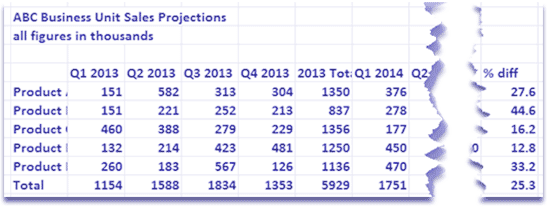
The first question you should ask when your boss requests the full spreadsheet on the slide is why they want to see the full spreadsheet. They are clearly looking for something, and it will save you a lot of time if you know what they are looking for. If they really only need to see the bottom line, just show them a clean visual or small table with the key figures. This is almost never the case unfortunately, so why else might they want to see so many numbers.
Filed Under:
Guest Posts
Tagged as: Dave Paradi, Excel, Guest Post, Opinion, PowerPoint
Comments Off on How do Spreadsheets End Up on Slides, and What You Can do Differently
How many times have you seen a picture of a light bulb on a slide? Your answer may be “many times”, and so we get you some thoughts on alternatives to overcoming this visual cliché. Claudyne Wilder then explores ways in which you can hold the attention of your audience. We also bring you the Bucket diagrams offer.
PowerPoint for iPad users will enjoy learning about removing Places and the AutoSave option. You can also explore how you can open files in PowerPoint Online. PowerPoint 2007 for Windows users can meanwhile look at altering between Curved and Straight line segments. Finally, don’t miss the new discussions and templates of this week!

Read Indezine’s PowerPoint and Presenting News.
Filed Under:
Ezine
Tagged as: Ezine, Indezine, News, PowerPoint
Comments Off on PowerPoint and Presenting News: July 28, 2015
You have learned what the Edit Points option in PowerPoint is, and how it works. The Points you see and edit give you control over how you want a shape to look appearance-wise. Even then, sometimes you might find it difficult to edit a certain segment (a part of the line between two points) in a shape because there are no points available to manipulate — or maybe there are far too many points! PowerPoint provides a simple solution for this problem — you can add and delete points in a shape.

Learn how to add or delete points (vertexes) for a shape in PowerPoint 2003 for Windows.
Filed Under:
PowerPoint 2003
Tagged as: PowerPoint 2003, Shapes, Tutorials
Comments Off on Learn PowerPoint 2003 for Windows: Add or Delete Points (Vertexes) for Shapes
Microsoft and the Office logo are trademarks or registered trademarks of Microsoft Corporation in the United States and/or other countries.