

David Tang is the founder of Flevy, the marketplace for business best practices–the same as those produced by top-tier consulting firms and used by Fortune 100 organizations. Flevy is the largest library of best practice documents available online. Prior to Flevy, David worked as a management consultant, where his clients ranged from startups to Fortune 15. David has a MEng and BS in Electrical & Computer Engineering from Cornell University. After Flevy, David created specialized sites such as PPT Depot and KPI Depot.
In this conversation, David talks about Balanced Scorecard and Strategy Maps on KPI Depot.
Geetesh: What prompted the Balanced Scorecard (BSC) tagging move, and how would you explain BSC in simple terms?
David: We noticed a pattern in how subscribers use KPI Depot. They’d browse a KPI group like Customer Service or Supply Chain and find 30 or 40 KPIs with full documentation, formulas, and benchmarks.
The question they kept coming back to was: “Which of these should I actually track?” That’s a prioritization problem and the Balanced Scorecard (BSC) is the best framework ever developed to solve it.
For readers who haven’t utilized the Balanced Scorecard for strategic management, the concept is simple. Most organizations default to tracking financial metrics: revenue, margins, costs. Those matter, but they’re lagging indicators. They tell you what already happened.
The Balanced Scorecard, developed by Robert Kaplan and David Norton at Harvard, says you should measure four perspectives: Financial (are we making money?), Customer (are our customers happy?), Internal Process (are our operations running well?), and Learning & Growth (are we building capabilities for tomorrow?). These form a causal chain. Invest in people and systems, processes improve. Better processes deliver more customer value. Happy customers drive financial results. When you only measure the financial layer, you’re looking at the scoreboard without watching the game.

We tagged every KPI in our database with its BSC perspective, because it transforms how you select metrics. Instead of a flat list of 40 KPIs, you immediately see which ones measure financial outcomes versus customer experience versus operational health. That turns KPI selection from an overwhelming exercise into a strategic conversation.
Geetesh: How does categorizing KPIs into the four perspectives help users think more clearly?
David: It forces balance. I’ve seen countless executive dashboards that are 80% financial metrics with one or two customer satisfaction scores bolted on. The teams building those dashboards aren’t being lazy. They’re defaulting to what’s easiest to measure and what leadership asks about first.
When you lay out KPIs by BSC perspective, gaps become visible. A leadership team might realize they have seven financial KPIs, four customer metrics, and nothing measuring internal processes or employee capability. That means no early warning system. By the time a problem shows up in your financials, you’re already months behind.
Most organizations don’t think this way natively. Most of the Fortune 500 and large enterprises already deployed BSC, but the majority of mid-size companies track metrics organically: whatever their ERP produces, whatever their board asks for, whatever peers mention at conferences.
The four-perspective structure brings a rigor that most teams find genuinely clarifying. Their existing KPIs aren’t wrong; they’re incomplete, and BSC shows them exactly where.
Geetesh: From a presentation perspective, how does the Strategy Maps feature improve how KPIs are communicated on slides?
David: The biggest problem with KPI slides is that they’re flat lists. “Revenue Growth: 12%” sitting next to “Employee Training Hours: 45 per quarter” gives the audience no sense of how those metrics connect. The presenter knows trained employees deliver better products which drive revenue, but the slide doesn’t show it.
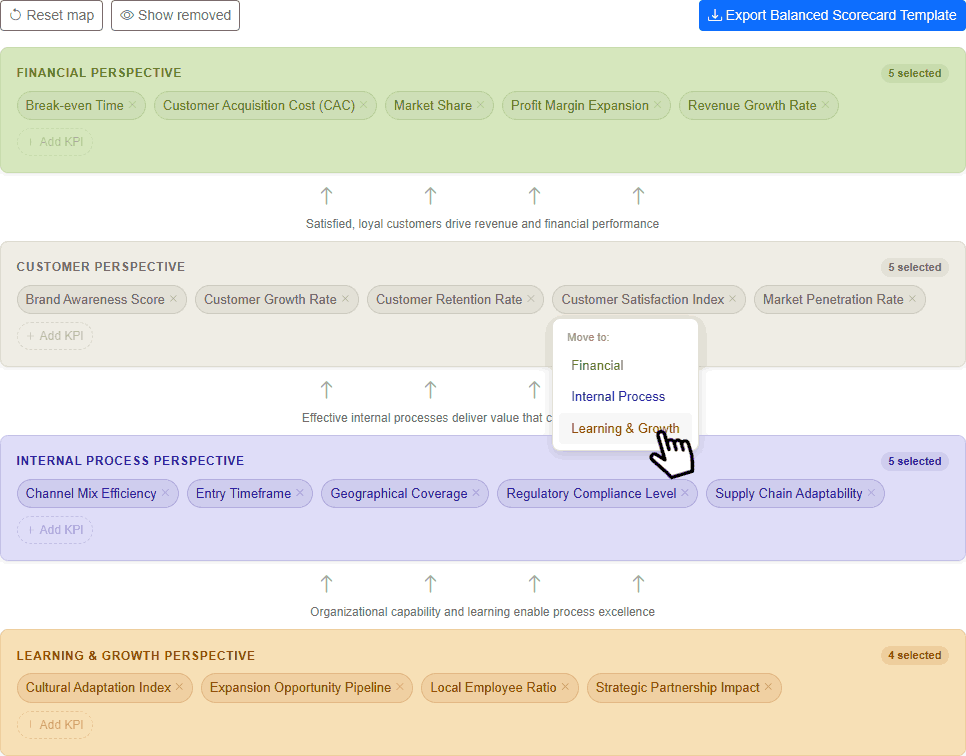
A strategy map fixes this by organizing KPIs into the four perspectives with a clear upward flow. The audience immediately sees that Learning & Growth metrics feed into Internal Process metrics, which drive Customer outcomes, which produce Financial results.
That’s not just a prettier layout. It’s a narrative structure. You’re showing cause-and-effect logic, not a data dump.
Our Strategy Maps feature lets subscribers build this interactively; then, export the result. Drop it into a board deck or quarterly review. Instead of a slide with 15 KPIs in a table, you have a visual that tells a strategic story in one glance. That’s the difference between a slide people skim and one that drives a 20-minute discussion.
Geetesh: How does this fit into your broader vision, and do you see these tools helping users move from numbers to storytelling?
David: KPI Depot started as a reference database for looking up what a KPI means, how to calculate it, and what good looks like based on benchmarks. The BSC features represent a shift from reference to action. We’re no longer just answering “what does this metric mean?” We’re helping people answer “which metrics should I track and how do they connect to my strategy?”
The broader vision across our platforms is to close the gap between strategy and execution. Flevy provides strategic frameworks and methodologies. KPI Depot provides the measurement system. The strategy map and scorecard tools connect those layers.
A consultant or strategy leader can go from “we need a Balanced Scorecard” to a curated, exportable scorecard template in 15 minutes, complete with documentation and benchmark data. That workflow used to require weeks of consulting.
On storytelling: numbers without context are noise. A slide that says “our NPS is 42” means nothing to most audiences. However, a strategy map showing NPS as a Customer metric, linked to Internal Process improvements in response time, enabled by a Learning & Growth investment in agent training? That’s a story.
It tells the audience not just where you are, but why and what happens next. That’s the kind of communication that moves decisions in a boardroom, and these tools make it accessible to anyone, not just management consultants who’ve spent 20 years building frameworks.
The views and opinions expressed in this blog post or content are those of the authors or the interviewees and do not necessarily reflect the official policy or position of any other agency, organization, employer, or company.
Related Posts
 David Tang is the founder of Flevy, the marketplace for business best practices--the same as those produced by top-tier consul...
 David Tang is the founder of Flevy, the marketplace for business best practices--the same as those produced by top-tier consul...
 David Tang is the founder of Flevy, the marketplace for business best practices--the same as those produced by top-tier consul...
 David Tang is the founder of Flevy, the leading provider of business frameworks and analysis tools. Flevy's mater...