
This is the print version of this page. All content is copyright Indezine.com 2000-2026.
Thoughts and impressions of happenings in the world of PowerPoint and presentations, continuously updated since 2003.
See Also:
PowerPoint and Presenting Notes
PowerPoint and Presenting Glossary
You know that PowerPoint and other Microsoft Office programs allow you to open and save files directly to your OneDrive folders. Other than OneDrive, PowerPoint also supports Dropbox as a cloud alternative.

Explore how to add Dropbox as a place in PowerPoint 365 for Windows.
Filed Under:
PowerPoint 365
Tagged as: Dropbox, Interface, Microsoft 365, Microsoft Windows, Office 365, Places, PowerPoint 365, Tutorials
Comments Off on Add Dropbox in PowerPoint 365 for Windows
We first feature Elizabeth Jordan and Larry Lyons of Toastmasters International, who explore how you can improve the efficiency and effectiveness of everyday meetings using parliamentary procedure. Their main reference is Robert’s Rules of Order, first written in 1876 and relevant in present times as well. We also bring you an amazing offer for the upcoming Present to Succeed annual presentation conference. This is an annual event being held in Sofia, Bulgaria, but you can join this event online as well, at a discounted rate especially for Indezine readers. This is your last chance to book this event.
We then explore digital signage using Microsoft PowerPoint and an add-in called DataPoint. In this feature, Kurt Dupont looks at digital signage for car dealerships, but this concept can be used for any storefront. We also bring you quotes, press releases, and templates from the last few days.

Stay informed about updated tutorials and happenings related to PowerPoint and presenting.
Filed Under:
Ezine
Tagged as: Ezine, Indezine, News, PowerPoint
Comments Off on PowerPoint and Presenting News: May 28, 2024
In a sign of changing times, when PowerPoint users are looking at the presentation program as a tool rather than a messenger, the US Marines has decided to overhaul its education methods to use PowerPoint better. This is a progression from the times of the famous Afghanistan slide.
The Marine Corps Times reported that ‘Instead of teaching them what to think, we’re teaching them how to think,’ said Col. Karl Arbogast, director of the policy and standards division at training and education command.

Image: Yay Images
Read more on the Marine Corps Times site.
The views and opinions expressed in this blog post or content are those of the authors or the interviewees and do not necessarily reflect the official policy or position of any other agency, organization, employer, or company.
Filed Under:
Thoughts
Tagged as: Death by PowerPoint, Military
Comments Off on Marines Say No More ‘Death by PowerPoint’
You can open and save files from any location on your computer or network, but did you know you can add even more places to access your files? In Backstage view, both the Open and Save As tabs give you options to add new file locations.
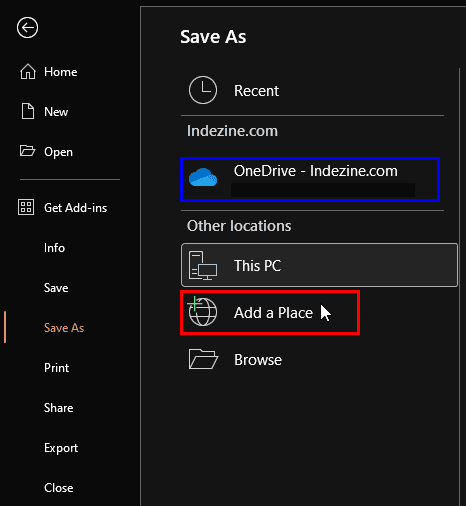
Learn to add places in PowerPoint 365 for Windows.
Filed Under:
PowerPoint 365
Tagged as: Interface, Microsoft 365, Microsoft Windows, Office 365, Places, PowerPoint 365, Tutorials
Comments Off on Add Places in PowerPoint 365 for Windows
By Elizabeth Jordan and Larry Lyons, Toastmasters International
If you’ve ever attended a meeting and left feeling unsure what it was meant to achieve, or, for example, left frustrated when it ran overtime and made you late for your next appointment, you’ll have probably wondered how such issues can be resolved.
An article in HBR entitled Stop the Meeting Madness reported survey results that supports the widespread dissatisfaction with meetings. Of the 182 senior managers who were surveyed across a range of industries, 65% said meetings kept them from completing their own work. 71% said meetings were unproductive and inefficient. 64% said meetings came at the expense of deep thinking and 62% said meetings missed opportunities to bring the team closer together.

Image: Yay Images
However, since meetings are the mechanism by which decisions are made and information is shared by millions of people daily, it is important that the people who attend consider ways to make them more productive and value-adding.
One approach to improving the efficiency and effectiveness of everyday meetings and to boosting attendee satisfaction is to apply parliamentary procedure, specifically Robert’s Rules of Order.
The book of Robert’s Rules of Order was first written in 1876 by Henry Martyn Robert to address the chaos he observed at many of the meetings he attended. The most widely used version of his book today is Robert’s Rules of Order Newly Revised, which has been updated multiple times since its original publication.
Robert’s Rules of Order describes the set of rules and codes that provide a structured framework for managing discussions, making decisions, and ensuring orderly conduct during meetings. With this systematic approach to conducting meetings, decisions are reached democratically, and desired objectives are achieved.
This article provides four tips on how the application of parliamentary procedure, based on Robert’s Rules of Order, can help to improve everyday meetings.
In parliamentary procedure, the role of the chair or facilitator, is pivotal to the success of the meeting. The chair should command the respect of the meeting and be seen to be fair to all. For example, calling people wishing to speak by their name, and allowing each person the same length of time to speak. By making sure the discussion is relevant to the topic in question, and ensuring the meeting stays on track. Another important role of the chair is in summarising what has been discussed at the end of each specific topic to ensure that everyone is given the same information regarding any decision that has been taken and the next steps to follow. This avoids the well-known problem of people leaving the meeting unsure of its purpose and what is required of them.
Under Roberts Rules of Order an agenda is considered essential to provide a clear structure for conducting meetings. A draft agenda should be circulated in advance of every meeting and be adopted’ at the start of the meeting. ‘Adopting the agenda’ sends a strong signal that attendees buy into the meeting and are ready to participate. The items on the agenda are then followed in a systematic manner, with each item addressed and discussed before moving on to the next one. This avoids the discussion becoming derailed and promotes a focused approach to the meeting. This, in turn, decreases the likelihood of important matters being overlooked. In fact, there are some people who feel strongly that without an agenda, there is no point attending a meeting, often summarised as: No agenda, No attenda.
There are times during meetings when the loud extrovert voices may dominate the discussion and exclude quieter more introverted members. Parliamentary Procedure offers a solution to this common problem. It provides a process by which the discussion takes place in an orderly manner. A person wishing to speak has to first address the chair, and the chair then has to call the person by name and invite them to speak, this respectful interchange helps to set the tone for an orderly discussion. In this way members, one after another, have a chance to express their opinion without interruption, leading to a more positive and productive discussion and decision making. Roberts Rules of Order also allow for people to challenge the chair (politely) if it is felt that the correct procedures are not being followed. It also allows for people to request work to be sent to a committee, adjourn the meeting and much more. This makes for an orderly and productive meeting using an established framework.
One of the major complaints about meetings is that most run over the allotted time. Robert’s Rules of Order offers opportunities to overcome this problem in many ways. The use of a process known as ‘unanimous consent’ to expedite non-controversial matters being addressed is a tool that could be used in everyday meetings. For example, the adoption of the agenda, the approval of the meeting minutes, moving a meeting to a new date and time could be dealt with in this manner. Having the agenda and related documents circulated in advance of the meeting increases the chance that people will arrive prepared and ready to participate ensuring that time is used efficiently. By enforcing time limits on discussions, people are encouraged to be clear and concise in their presentations. The effect of adhering to these rules is an efficient use of time and more productive meetings.
The Parliamentary Procedures which are outlined in Roberts Rules of Order, have offered a time-tested framework for meetings for almost one hundred and fifty years. Nowadays where meetings are often international, diverse and complex, this framework is needed more than ever. In summary, it provides a way to hold fair, focused and productive meetings where diverse views can be voiced, and decisions can be made in a timely and inclusive. All of which will achieve greater satisfaction levels amongst meeting participants.

Elizabeth Jordan is Director D71, and Larry Lyons is Parliamentarian D71 at Toastmasters International, a not-for-profit organisation that has provided communication and leadership skills since 1924 through a worldwide network of clubs.
There are more than 400 clubs and 10,000 members in the UK and Ireland.
Members follow a structured educational program to gain skills and confidence in public and impromptu speaking, chairing meetings and time management.
To find your nearest club, visit Toastmasters International.

The views and opinions expressed in this blog post or content are those of the authors or the interviewees and do not necessarily reflect the official policy or position of any other agency, organization, employer, or company.
Filed Under:
Guest Posts
Tagged as: Guest Post, Meetings, Toastmasters
Comments Off on Introduce Parliamentary Procedure to Improve Everyday Meetings
Microsoft and the Office logo are trademarks or registered trademarks of Microsoft Corporation in the United States and/or other countries.