

Simon Raybould started his career as a research scientist and then the center manager at the world’s second most influence unit of its kind! His PhD looked at the causes of childhood leukemia. He’s also been a lighting designer for dance companies, a playwright and author, teacher, trainer and fire-eater. Fire eating earns more money per hour than the others, but his wife objected to sleeping with someone who smelled of paraffin! 😉
In this conversation, Simon talks about his book, StoryMaking: How to Use Stories, Not Just Tell Them.
Geetesh: Many books focus on storytelling for presenters, but your new book, StoryMaking: How to Use Stories, Not Just Tell Them, takes a unique approach. Can you share more about the book and what sets your perspective apart?
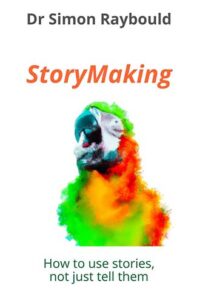
Simon: I’ve put a lot of time and energy into researching StoryMaking – at heart I’m still the research scientist I was for the first few decades after my PhD – so while little bits of it is obviously my opinion I tend to work in a much more empirical way than most presentation trainers. It’s important to me that we have tools that work for most people, most of the time, not “what worked for me”.
We’re living in a world where we’re absolutely bombarded with stories. Storytelling is the Next Big Thing! It’s touted as the solution to all problems in presentations, marketing and sales… but that’s just tosh – and it annoys me. What we should be talking about is the right stories, told in the right way. Stories are tools, just like a spade.
If you want to get a small hole you use a spade but for a big hole you use a mechanical digger. The right tool for the job.
Think of it this way – if you want to impress someone with your product or service you tell a short story about someone who’s used that service, not a funny story about when you got lost in New York. If you want to get people to warm to you, you’ll be better off telling a tactically chosen story about a weakness you’ve got or a mistake you made.
On the other hand, if you want to influence someone you tell a story of someone like them (but not too like them!).
I’m sure you get the idea. Different lengths, styles, points of view, heroes … they all impact upon what type of story you should use.
What’s pretty clear though, is that the big, heroic stories we all like to tell and which we’re bombarded with all the time tend to be less effective than we think. A story of against the odds heroic success, like a Batman film, is entertaining and your audiences will love it at the time but any motivational effect it has wears off in just minutes to hours for most people.
That’s what StoryMaking is about – getting past the mindlessly parroted mantra of “tell stories” to thinking about how we use stories as tools and resources. It’s a pretty forensic examination of how to find, store, recall and deploy the right story for maximum effect. It’s a book about using stories that’s got graphs in it! That should tell you what you need to know! 😀
Geetesh: Unlike many other resources, your book doesn’t offer a “magic formula” for creating and sharing stories. Does that make it more challenging for readers to incorporate stories into their presentations?
Simon: The problem with any magic formula is that if it works at all, it only works in the exact same circumstances as it was designed in. That’s no use to most people, because they’re not in identical circumstances. Unless you’re talking about computer hardware life is too messy and complicated for that.
What I do instead is explain to people the principles that sit behind things. It’s a little bit more hard work for people, because they’ve got to think, but the upside is that the things I’m giving them are much more likely to actually work – and to be useful in a whole range of circumstances.
If I explain how to find something called a “Hope So” story, you know how to find them for yourself and how to use them. If I’d just told you to “use this story” you’d be stuck in almost every situation except the one I was in when I told you what to do.
I know people are short of time and want a copy-paste answer, but we’ve all been in a situation where we’ve tried to follow a recipe that says something like “cook for 45 minutes” and it’s not quite worked – perhaps because our oven isn’t quite as hot as the other person’s. On the other hand if I’ve been taught how to tell if something’s ready to serve I can adjust cooking times for myself.
Frankly, it’s more interesting too, and a lot more fun to do things my way. 😊
For example, I’ve just spent some time coaching a client for a TEDx on internet safety for children. I could have just said “use this story”. Instead I spent time explain what sort of stories would be most impactful and why. That means that not only does she have a cracking TEDx, (just released on the TED website) but she now knows how to find stories for herself next time.
It took me a long time to teach my daughters to drive when it would have been quicker to give them lifts… but now they can drive I don’t have to take them anywhere!
Geetesh: How do you think the role of stories in business presentations is evolving? Would you say stories are a universal solution to all presenting challenges?
Simon: For a professional storyteller and storytelling trainer it might surprise people to find out I don’t think stories are a panacea. They don’t solve all presenting challenges. Other tools like PowerPoint don’t solve all challenges, so why would tools like stories?
We’ve all seen awful slides, just like we’ve all heard pointless stories.
Stories have a bit of an advantage there though – even if a story is pointless, I can at least make it interesting. A boring slides boring whatever you do to it. 😉
I’d like to think that the role of stories is evolving… moving on from being counter-productive “hero stories” to being more useful tactical stories that can be used to explain and illustrate. Stories become more of a pragmatic tool than the mythological nonsense they were sold to us as!
The views and opinions expressed in this blog post or content are those of the authors or the interviewees and do not necessarily reflect the official policy or position of any other agency, organization, employer, or company.
Related Posts
 Simon Raybould is a speaker and trainer. As a speaker, he specializes in resilience, emotional robustness, public speaking, an...
 Gavin McMahon is a founder and Chief Content Officer for fassforward consulting group. He leads the design and product development of fass...
 Luka Krejči helps people rethink how they share ideas, influence others, and ultimately earn that Yes from the audience. To increase the c...
 Simon Raybould started his working career investigating at the causes of childhood leukemia and spent 24 years as a researcher...